Call Us Now: 504-732-9714
Call Us Now: 504-732-9714

Removing a large tree is a different discipline from removing a small one. The weight of individual limbs, the reach required to get to them, and the near total absence of a safe drop zone in a built-up neighborhood all change the method. This guide explains what makes big trees harder, the equipment and techniques crews use, and what a homeowner should expect from planning through cleanup.
Crews think less about height than about mass and reach. A tree becomes a large-tree job when individual sections weigh more than people can safely handle by hand, when the canopy extends over structures, or when the climb exceeds what standard equipment reaches comfortably.
Green wood is heavy. A limb that looks manageable from the ground can weigh several hundred pounds, and a trunk section can weigh far more than that. Everything about the job follows from that weight, because it determines whether a piece can be dropped, must be lowered on a rope, or has to be picked by a crane. Big Easy Tree Cutting assesses this on site before quoting, because the answer changes the entire approach.
In an open field a large tree can sometimes be felled whole. On a typical New Orleans lot, the canopy covers the house, the neighbor’s fence, and the power drop simultaneously. Every piece has to be controlled from the moment it is cut until it reaches the ground.
A piece of wood falling even a short distance onto a rope generates forces well above its static weight. Rigging points, ropes, and hardware have to be selected for those peak loads rather than for what the piece weighs sitting still. Getting this wrong damages trees, equipment, and whatever is underneath.
Many large trees come down precisely because they have decay, and decay is what makes climbing them unsafe. A climber’s anchor point depends on sound wood, and a hollow stem cannot be trusted. When internal condition is doubtful, crews move to a lift or crane so nobody is relying on the tree’s structure.
The machinery that makes large removals safer also needs room to get in and set up. A crane needs a stable, level position with clearance for the boom. Narrow historic lots, overhead lines, soft ground, and shared driveways all limit where equipment can go, and sometimes the tree is simply out of reach.
A big tree produces a large volume of wood and brush. That means more chipping, more truck trips, and a longer cleanup phase. It also means the staging area needs enough room to hold material between loads.
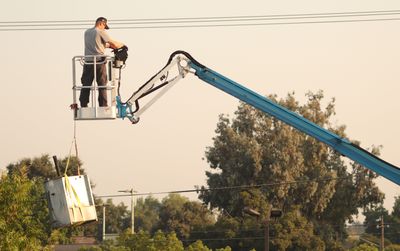
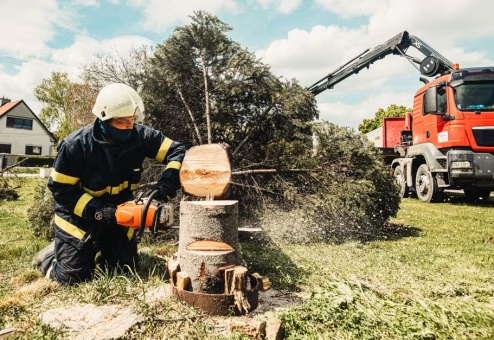
The general sequence is to reduce the canopy first, then work down the stem. Outer limbs come off to remove weight and open space, then progressively larger sections are taken. Each piece is either lowered on a rigging line, picked by a crane, or dropped into a cleared area when one exists.
Crane-assisted removal has become common for large trees in tight spaces. A climber or a worker in a lift sets a sling, the crane takes the weight, and the cut piece is lifted clear rather than swinging on a rope. It is faster, it puts less shock load into the tree, and it keeps heavy wood away from the house entirely. It also requires a setup position and a clear flight path, which is not available on every lot.
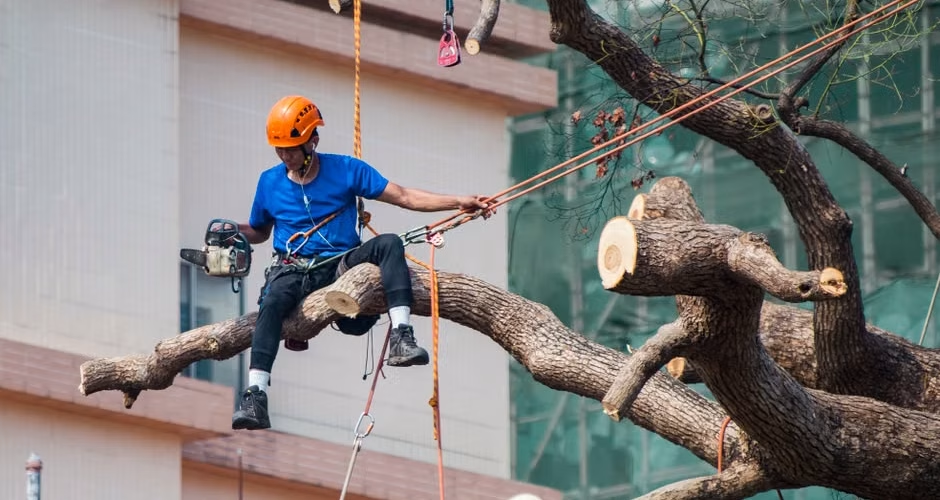
Where a crane cannot reach, the work is done with traditional rigging: blocks, friction devices, and lowering lines that let a ground crew control the descent of each piece. This is slower and demands more of the crew, and it is how most removals in dense neighborhoods still get done.
The stem of a large tree is dealt with last and often produces the biggest pieces of the job. Sections are cut to a size the crew can move, either rolled to a truck, lifted by machine, or cut small enough to carry.
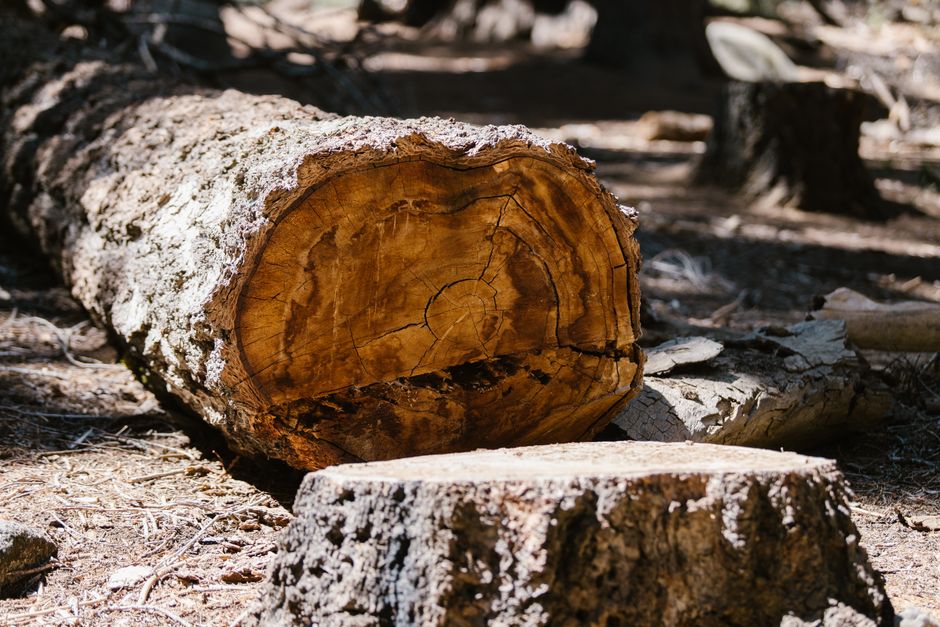
Homeowners sometimes want the trunk left for milling or firewood. That is usually possible if you say so during the estimate, since it changes how sections are cut and where they are stacked. It also reduces hauling. Decide early rather than mid-job, because a trunk cut into short rounds cannot be un-cut for a sawmill.
Before committing to removing a big tree, it is worth asking whether it truly needs to go. Mature canopy in this city takes generations to establish, and a large tree that is structurally sound is worth keeping even if it requires maintenance.
Options short of removal include reducing the crown to lower wind load, cabling or bracing weak unions, and clearing limbs off the roofline. Our page on crown reduction and lifting covers the first of those. For live oaks specifically, see our guide to caring for live oaks in New Orleans and our oak tree trimming service.
Local requirements can also apply, particularly for larger trees, trees in the right of way, and removals tied to construction. Requirements vary by jurisdiction, so confirm with the applicable city or parish department before scheduling. For project work, our construction permitting service manages that process.
Plan for a longer job than a standard removal, more equipment on your street, and a bigger footprint of activity. Preparation matters more here than on a small job, and our checklist on preparing your property for tree removal covers what to move and when. Our guide to how long tree removal takes explains the factors that stretch a timeline.
This is also the category of work where attempting it yourself goes wrong most severely. Our post on the dangers of DIY tree removal covers why.
Every large removal starts with someone standing under the tree working out how it comes apart. We provide tree removal and stump grinding across the communities listed on our service area page.
Contact Big Easy Tree Cutting or call 504-732-9714 to arrange an on-site assessment.
No. A crane is one option among several and depends on access, the setup position available, and what sits beneath the canopy. Many large removals in dense neighborhoods are completed with climbing and rigging alone. Where a crane can be positioned safely, it often shortens the job and keeps heavy wood away from structures.
That is the entire purpose of controlled dismantling. Sections are lowered on ropes or lifted clear rather than dropped, and the sequence is planned around what sits underneath. No crew can promise a perfect outcome in every circumstance, which is why insurance coverage and an experienced crew both matter on this kind of job.
Time, equipment, and risk all scale with size. Large removals involve more rigging, sometimes a crane or lift, a bigger crew, considerably more material to process and haul, and a longer cleanup. Access difficulty often adds more to a quote than height does, which is why estimates require seeing the site.
Usually yes, if you say so before work starts. Cutting for a sawmill means longer sections and different handling than cutting for hauling, and the decision affects where wood is stacked. Raising it after the trunk has been cut into short rounds is too late, so mention it during the estimate.
Requirements vary by jurisdiction and by where the tree stands, and trees in the public right of way, under easements, or covered by a specific ordinance can be treated differently from trees entirely on private property. Construction-related removals may involve additional review. Confirm current requirements with the applicable city or parish department before scheduling.
Frequently it can. Crown reduction lowers wind load, cabling and bracing can support weak unions, and clearance pruning solves conflicts with a roof. Whether these are appropriate depends on the structural condition of the tree, which is what an on-site assessment determines. Removal should be the conclusion rather than the starting assumption.
 By Admin
  Aug 25, 2026