Call Us Now: 504-732-9714
Call Us Now: 504-732-9714

Tree roots get blamed for a great deal of damage they did not cause, and occasionally they are genuinely the problem. Sorting out which is which matters, because removing a tree that was not the cause leaves you with the same cracked slab and one fewer tree. This guide covers how roots actually interact with foundations, sewer lines, and hardscape, when removal is the right answer, and the less drastic options worth trying first.
Roots do not seek out pipes or push through concrete out of ambition. They grow where conditions favor growth, which means where there is oxygen, moisture, and room. In the heavy, poorly drained soils common around New Orleans, that generally means shallow and wide, with most of the root mass in the top foot or two and spreading well beyond the branch spread.
That behavior explains most of what follows. Roots exploit openings that already exist rather than creating them, and they thicken over years in whatever space they occupy. A root that found a gap in a pipe joint is a symptom of a joint that had already failed. Understanding this changes the conversation from blame to diagnosis, and Big Easy Tree Cutting would rather help you diagnose the problem than sell you a removal you did not need.
Roots rarely crack a foundation by pushing on it. The more common mechanism is indirect and involves soil moisture. In soils that shrink when dry and swell when wet, a large tree drawing water from beneath one part of a slab can contribute to uneven soil moisture and differential movement.
The important qualification is that this is one possible contributor among several. In our area, foundation movement is frequently associated with subsidence, organic soils, drainage problems, plumbing leaks, and the age and construction of the structure itself. Attributing a cracked slab to a nearby tree without investigating those other factors is a good way to remove a tree and keep the crack.
If you have foundation movement, get a structural engineer or a qualified foundation professional to assess it before deciding a tree is responsible. That assessment can consider the soil profile, drainage, plumbing, and the pattern of movement, none of which a tree service is qualified to evaluate. Where a tree genuinely is a contributing factor, removal or root management can be part of the solution rather than the whole of it.
This one is more clear-cut. Roots enter pipes through existing cracks, failed joints, and deteriorated sections, drawn by the moisture and nutrients inside. Older clay and cast iron laterals are the most vulnerable because of how they are jointed and how they age.
Once inside, roots grow into a mass that catches debris and slows flow. The usual symptoms are recurring slow drains and repeat backups in the same fixture, often getting worse over months. A camera inspection by a plumber is the diagnostic step, since it shows whether roots are present, where, and whether the pipe itself has failed.
Removing the tree stops new root growth toward the line, though it does not repair the pipe. If the lateral is old and compromised, replacement or lining is the actual fix, and a modern properly jointed line is far more resistant to intrusion. Removing the tree without addressing the pipe often just delays the next problem.
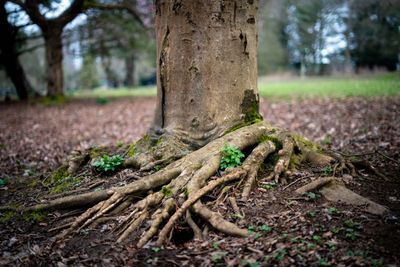
Surface roots lifting concrete is the most visible root problem and the easiest to diagnose. A root growing beneath a slab thickens each year, and the slab is the path of least resistance.
The result is a trip hazard, a repeat repair cost, and a surface that cracks again after each fix. Some species are far more prone to it than others, and a shallow-rooting tree planted close to a walk will keep doing this for as long as it stands.
Options short of removal exist. Some roots can be pruned, though cutting structural roots near a trunk trades a hardscape problem for a stability problem and should never be done casually. Redesigning the hardscape around the root, using flexible paving, bridging the root, or rerouting a walk can all work. Where the tree is small, the conflict is severe, and the hardscape must stay, removal may be the practical answer.
Removal is permanent and a mature tree is not quickly replaced, so work through the alternatives first.
Root barriers installed between a tree and a structure can redirect growth downward, and they are most effective when installed before a conflict is severe. Selective root pruning by a qualified arborist can address specific conflicts, though it must be planned around what the tree needs for stability. Repairing or replacing a failing sewer lateral solves the intrusion problem at its source. Adjusting irrigation and drainage can reduce the moisture gradients that contribute to soil movement. Redesigning hardscape around a root is often cheaper than a removal plus the eventual replanting.
Where a tree does need to come out, our guides on when a tree needs to be removed and hazardous tree warning signs cover the wider assessment, and crown reduction is worth considering where the conflict is with the canopy rather than the roots.
Removing the tree ends new root growth, but it does not clear the existing root system. Those roots stay in the ground and decay over years, and grinding the stump removes only the stump and the immediate root flare. For most purposes that is fine. Where you plan to build, pour concrete, or install a pool, more extensive excavation may be needed. Our post on what happens to tree roots after removal covers this in detail, and our stump grinding service handles the stump.
Root conflicts are almost always planting decisions coming due decades later. When you replant, put large species well away from foundations, laterals, and hardscape, and choose smaller species for tight spots. Our guide to replanting after tree removal in Louisiana covers species selection and placement for our conditions.
We will tell you honestly whether we think your tree is the cause, and when the right next call is a plumber or a structural engineer rather than us. We provide tree removal and tree trimming across the communities on our service area page, and our FAQs page answers more common questions.
Contact Big Easy Tree Cutting or call 504-732-9714 for an assessment.
Roots rarely crack a foundation by direct pressure. The more common mechanism is indirect, where a large tree draws moisture from soil beneath part of a slab and contributes to uneven movement in soils that shrink and swell. In our area foundation movement is frequently associated with subsidence, drainage, plumbing leaks, and construction as well, so have a structural engineer or foundation professional assess it before concluding a tree is responsible.
Recurring slow drains and repeat backups in the same fixture, worsening over months, are the usual symptoms. A camera inspection by a plumber is the diagnostic step and shows whether roots are present, where they entered, and what condition the pipe is in. Roots enter through existing cracks and failed joints rather than boring through sound pipe.
It stops new root growth toward the line, but it does not repair the pipe. If the lateral is old and compromised, replacement or lining is the actual fix, and a modern properly jointed line resists intrusion much better. Removing the tree without addressing the pipe often just postpones the next blockage.
Sometimes, but it has to be planned rather than improvised. Cutting structural roots near the trunk can compromise stability and trade a hardscape problem for a failure risk. A qualified arborist can assess which roots may be safely pruned and where a root barrier or hardscape redesign is the better option.
Shallow-rooting, fast-growing species planted close to structures and hardscape are the usual culprits, and placement matters as much as species. Almost any large tree planted too close to a walk, a lateral, or a foundation will eventually create a conflict. Matching mature size and rooting habit to the location when planting prevents most of these problems.
Generally no. Without a canopy the roots lose their supply of sugars and stop extending, so the risk of new intrusion ends with the tree. The existing roots remain in the ground and decay over years, and stump grinding removes only the stump and the immediate root flare. More extensive excavation is needed where you plan to build or pour over the area.
 By Admin
 Sep 29, 2026