Call Us Now: 504-732-9714
Call Us Now: 504-732-9714

The correct decision between stump removal and grinding is purely a matter of comprehending your property’s short-term needs and long-term aspirations with Big Easy Tree Cutting.
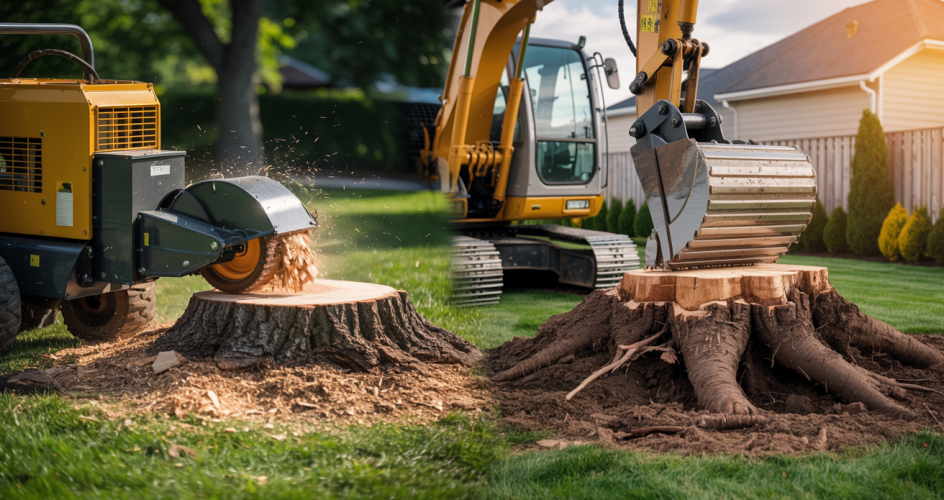
Stump grinding entails grinding the stump below grade level. This process retains the roots in the ground, whereas removal involves cutting out the root system together with the entire stump. Grinding takes less time and is less invasive, hence more suitable for landscaping, but removal stops regrowth.
Both methods have their benefits, so it’s really about your budget, your long-term goals, and the size of the tree.
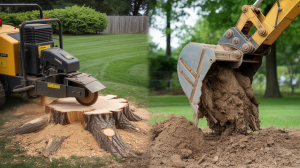 Stump grinding is another workable, more precise method of removing tree stumps, using a specialized piece of equipment called a stump grinder. Stump grinders are very specialized and will grind the stump down to the grade line or 6 to 8 inches below grade. The machine can grind the stump and mulch it up into bigger pieces.
Removal can be cumbersome because it means extracting the entire stump and root system from underneath the ground, which can be very hard to do. Removal may require, depending on size, heavy machinery or a skid steer or winching techniques to pull out deep and extensive roots, which can be over 30% of the total biomass of a tree.
Do you want to know the difference between stump grinding and stump removal? There are a variety of factors in the practices and machinery involved, also consider how this may affect your property, along with the long-term price. These important differences are what let you determine which method is best suited to you.
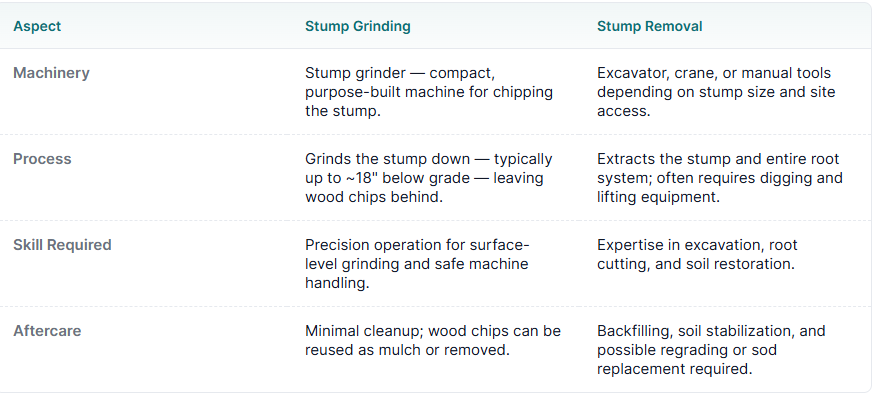
Removal involves taking out the entire stump and root system, while grinding means using a grinder to grind the stump into wood chips. Removal takes much heavier machinery to remove it entirely, often creating a cavity that needs repair.
Stump grinding removal cost comparison, hidden costs. Though stump grinding is generally cheaper, since it takes less manpower and machinery than removal. Removal, on the other hand, is much more expensive because it’s more complicated. Other costs can come into play, such as soil restoration or landscaping replacement post-removal. If there’s regrowth or a pest problem develops, follow-ups with grinding may be required.
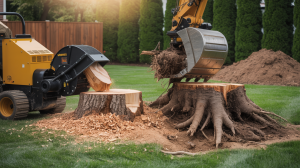 Grinding takes less time, typically getting done in less than two hours. Removal requires more time because of the excavation and cleanup process, particularly for sizable stumps or complex root systems. Grinding has the added benefit of allowing immediate use of the ground area, whereas removal often necessitates a wait for landscaping.
Removal, on the other hand, causes major disturbance, often taking down surrounding trees and plants, and severely disrupting the soil. The entire root system will completely rot over time. While removal creates a clean slate, it creates quite a hole, necessitating stabilization of the soil and any potential alteration of the surrounding ecosystem.
Grinding minimizes the likelihood of regrowth, but does not completely remove it, since roots can still reform new growth. Removal prevents any possibility of regrowth, since the root system is completely removed—perfect for invasive or otherwise undesirable trees.
Whether stump grinding or removal is right for you ultimately comes down to your needs, budget, and long-term plans for your property. Choose grinding if you wish to have a quicker, less intrusive solution. It removes the majority of the roots, but allows you to maintain a clean, safe yard during the process. If your objective is to eliminate the entire stump and root system, then removal is the clear choice.
Like any other method of stump and root management, each option has pros and cons, and the best choice for you is based on what addresses your needs best. If you’re still unsure, consulting with a professional from Big Tree Cutting can help you weigh the benefits of each option. So, are you looking for efficiency or a more complete solution? We are the tree service you can trust that will help you make the right decision for your landscape!
 By Admin
  Sep 15, 2025