Call Us Now: 504-732-9714
Call Us Now: 504-732-9714

After a storm passes, the instinct is to start clearing. A better first move is to work through the property systematically, because not every damaged tree needs to come down and the ones that do are not always the ones that look worst. This step-by-step guide covers safety, triage, documentation, the removal itself, and the recovery work that follows.
Walk the property only once the weather has genuinely passed, and keep the walk to observation. Treat every downed or sagging wire as energized, including anything draped over a fence, a car, or standing water, and report it to your electric utility.
Look up as you move. Broken limbs frequently stay lodged in canopies and drop hours or days later without warning. Rope off or simply avoid any area beneath a canopy that has visible damage, and keep children and pets inside until the property has been checked properly. Our guide to emergency tree removal in Louisiana covers the immediate response when a tree has struck a structure.
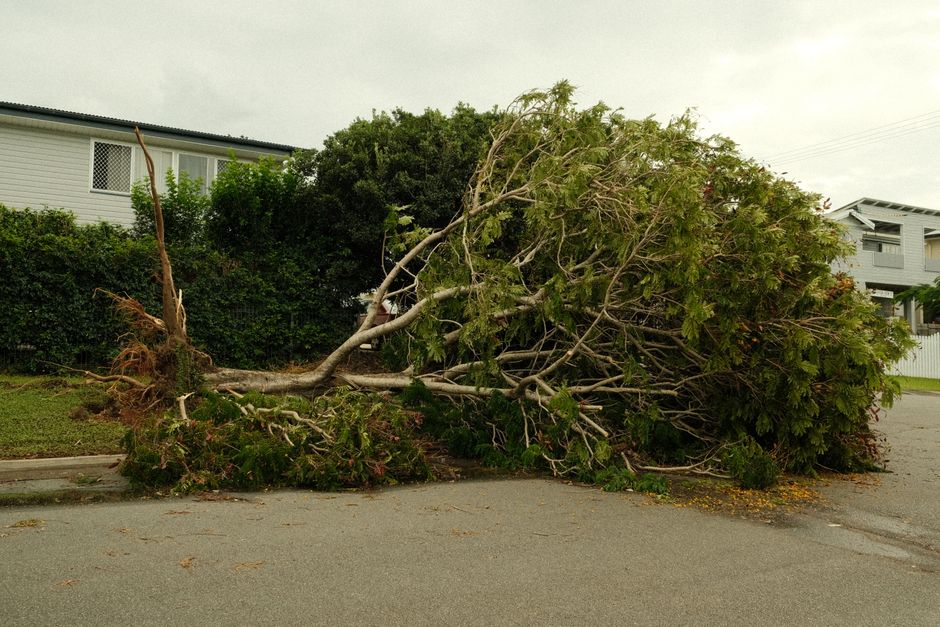
Document the scene before any cleanup begins. Wide shots establish context, close shots show the failure surface and the point of impact, and photographs of the base show whether roots lifted.
Include timestamps where your camera supports it, and capture damage to structures, fences, vehicles, and landscaping separately. This documentation supports whatever claim you file, and it cannot be recreated once material has been moved. Our post on whether insurance covers tree removal in Louisiana covers what insurers commonly ask for, though the specifics of any claim depend on your policy and should be confirmed with your insurer.
This is where a systematic approach pays off. Sort damaged trees into three groups rather than treating them all the same.
Trees resting on a structure, hung up in another tree, leaning newly toward a target, or showing a lifted root plate belong in this group. So do trees with a large crack through a main stem. These need professional attention before anything else, and the area beneath them should stay empty.
A tree that has lost some branches but retains most of its canopy, has an intact trunk and root system, and shows no major stem cracks can often recover. Broken limbs can be cut back to proper positions so the tree can seal the wounds. Trees in this group benefit from patience rather than a decision made in the first week.
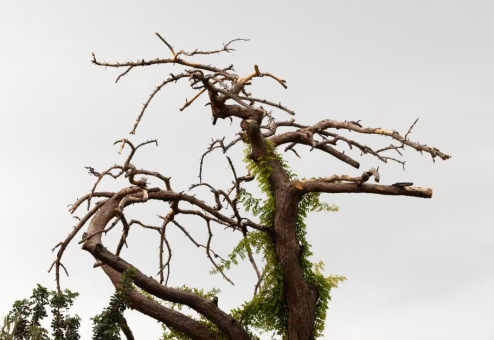
Trees that have lost most of their canopy, split at a main union, lost a significant portion of the trunk, or lifted substantially out of the ground are generally not recoverable. The signs overlap heavily with those in our guide on when a tree needs to be removed.
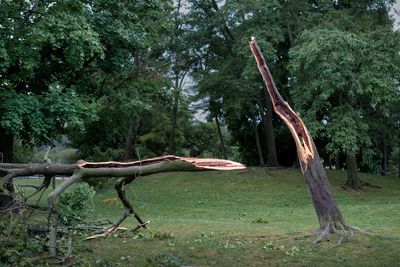
Storm triage is harder than it looks, because the visible damage and the structural damage are not always in the same place. A tree that lost a dramatic limb may be structurally fine, while a tree that looks intact may have a cracked union or a partially failed root plate.
An arborist assessment looks at the root zone for lifting and cracked soil, sounds the trunk for hidden decay, checks unions for separation, and evaluates whether the remaining canopy can support the tree. That assessment is what separates a tree that should come down from one that should be pruned and watched. Resist the pressure to decide quickly on trees that are not immediate hazards.
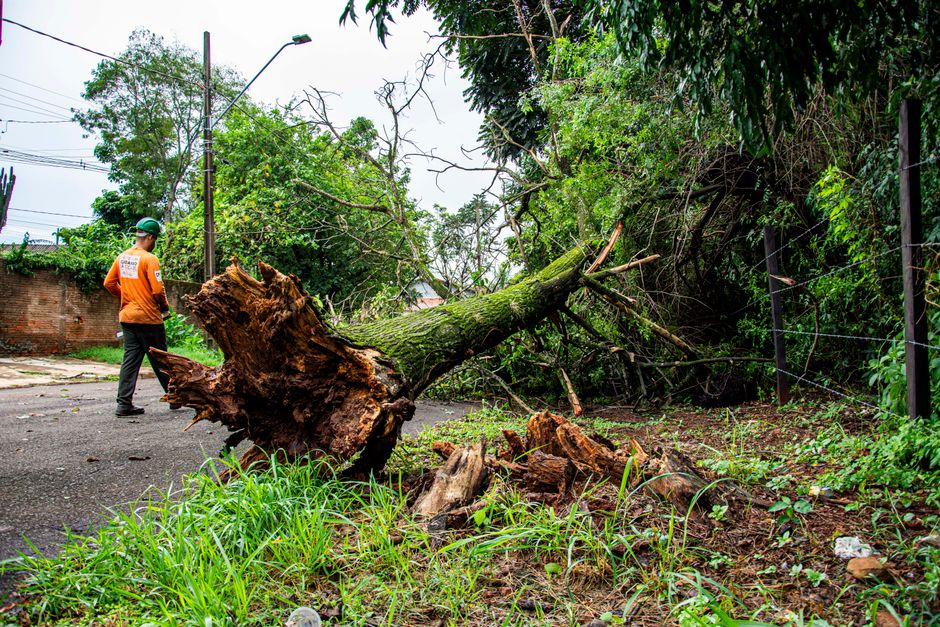
Storm-damaged removal differs from a planned one in a way that matters. The wood is under load, and it is under load in ways that are difficult to read. Trunks resting on structures, limbs bent and held by other debris, and partially separated unions all store energy that releases when cut.
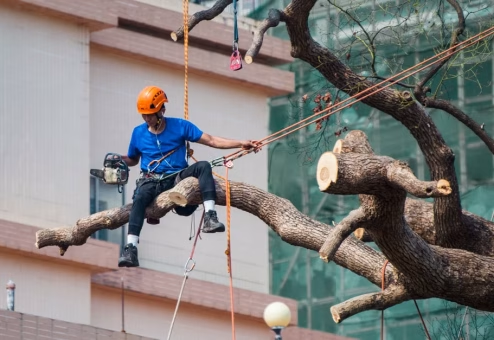
Crews handle this by working out what is holding the tree before touching it, securing the trunk with rigging so nothing shifts toward a structure, and cutting in a sequence that releases tension gradually. On a tree resting on a roof, the goal is to take weight off without letting anything drop further. Where a crane or lift can reach, sections are lifted clear rather than swung on ropes.
This is emphatically not homeowner work. Storm cleanup is where most serious chainsaw injuries happen, and the mechanism is almost always wood moving in an unexpected direction.
Trees in the recoverable group need proper cuts rather than a cleanup. Broken branches should be cut back to a lateral branch or to the branch collar so the tree can seal the wound, instead of being left as torn stubs that invite decay.
Avoid the temptation to top a damaged tree to “balance” it. Cutting main limbs back to stubs produces weak regrowth and decay entry points, and it makes the tree more likely to fail in the next storm rather than less. Where a canopy genuinely needs reducing, crown reduction performed with proper cuts is the correct technique. Our post on tree trimming after a storm covers the approach, and our emergency tree trimming service handles urgent cases.
Storm-damaged trees that survive the event can still decline over the following seasons. Root damage in particular takes time to show, and a tree that looked fine in the fall may leaf out poorly the following spring.
Watch for sparse or undersized leaves, dieback in the upper canopy, and any change in lean. Give trees a full growing season before concluding they are recovering, and have anything that looks worse rather than better reassessed. Our guide to tree care after a storm in New Orleans covers the follow-up, and stump grinding handles what is left where a tree came out.
If a storm has moved through and you are not sure what needs to come down, have it looked at before you decide. We provide tree removal and storm response across the communities on our service area page.
Contact Big Easy Tree Cutting or call 504-732-9714 to arrange an assessment.
Trees that keep most of their canopy, have an intact trunk with no major cracks, and show no sign of root lifting can often recover with proper pruning. Trees that split at a main union, lost most of their canopy, or lifted out of the ground generally cannot. The visible damage does not always match the structural damage, which is why an on-site assessment is worth getting before deciding.
Small branches lying loose on open ground are usually manageable. Anything under load, lodged in a canopy, resting on a structure, or near a wire should be left alone, because storm-damaged wood releases stored energy unpredictably when cut. Most serious chainsaw injuries in storm cleanup happen this way.
Immediate hazards need attention right away, meaning anything on a structure, hung up, newly leaning toward a target, or with a lifted root plate. Trees that are damaged but stable can wait for a considered assessment, and rushing that decision often results in removing trees that would have recovered. Give the non-urgent ones time.
No. Topping produces weak, poorly attached regrowth and opens large wounds that invite decay, which tends to make a tree more likely to fail in a future storm rather than less. Where a canopy needs to be smaller, crown reduction with proper cuts to lateral branches is the appropriate technique.
That depends on your policy, the cause of the loss, and what the tree damaged, so the answer has to come from your insurer. Photograph everything before moving it, notify your carrier promptly, ask what they need before cleanup starts, and request an itemized invoice that separates emergency work from routine cleanup.
Yes, and root damage is the usual reason. Damage below ground takes time to show above ground, so a tree can look acceptable immediately after a storm and decline over the following seasons. Watch for sparse leaves, upper canopy dieback, and any change in lean, and have trees that look worse rather than better reassessed.
 By Admin
  Sep 15, 2026