Call Us Now: 504-732-9714
Call Us Now: 504-732-9714

A hazardous tree is not simply an unhealthy one. Risk in arboriculture is a combination of a defect that makes failure likely and something valuable positioned where the failure would land. Understanding both halves lets you tell the difference between a tree that needs attention this month and one you can watch for another season. Here is what to look for and how to weigh it.
Professional tree risk assessment considers three things together: the likelihood that a part of the tree fails, the likelihood that the failing part strikes something, and the consequences if it does.
That framing explains outcomes that seem inconsistent from the outside. A badly decayed tree in the middle of an empty field may be left standing because nothing is beneath it. A tree with a modest defect directly over a child’s bedroom gets addressed immediately. The defect alone does not decide the answer. What sits underneath matters just as much, and Big Easy Tree Cutting assesses both when walking a property.
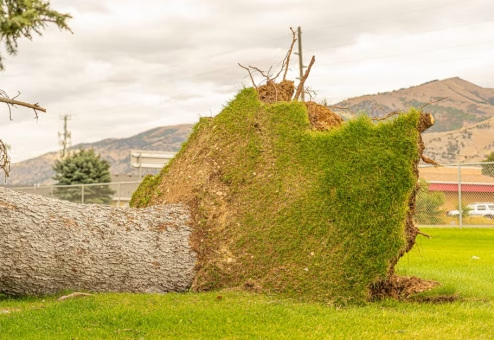
Start every inspection here, because root problems are the most serious and the most easily missed.
Root damage from construction is a slow-motion problem. A tree whose roots were cut during a driveway replacement can look normal for several seasons before it declines or fails. If work was done near a tree in the last few years, note it and mention it during any assessment.
Vertical cracks running for a distance along the stem indicate separation. A crack that opens and closes as the tree moves in wind is more concerning than a long-healed seam. Cracks that pass through a union between stems are among the more serious defects.
A hollow trunk is not automatically a hazard, since trees compartmentalize decay and much of a trunk’s strength lies in its outer wood. The questions are how much sound wood remains around the cavity, where the cavity sits relative to the load, and what is beneath the tree. This is a judgment that benefits from professional assessment rather than guesswork.
Fruiting bodies on the trunk or a main limb indicate that internal decay has advanced far enough for the fungus to reproduce. By the time they are visible on the outside, wood loss inside is typically well established. Our guide on how to spot tree disease covers what different symptoms suggest.
Swellings and raised ribs often mark where a tree has added wood in response to an internal defect. Patches of dead or missing bark with no callus forming around the edge indicate the tissue behind them has died.
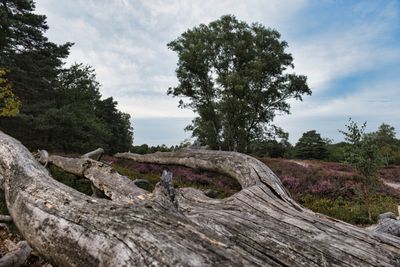
Look for included bark, meaning two stems joined at a narrow angle with bark trapped between them rather than wood grown together. These unions are weak and are a frequent failure point in high wind, particularly on trees with codominant stems.
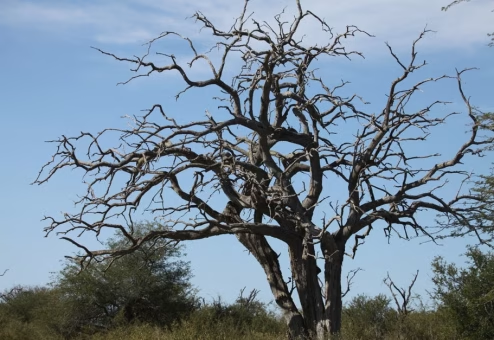
Dead wood distributed through the upper canopy suggests the tree cannot supply its outermost tips, which is a decline indicator rather than a normal shedding pattern. Our post on dead branches on a tree covers how to tell the difference. Broken limbs still lodged in the canopy after a storm are an immediate hazard regardless of the tree’s overall health.
Also compare the tree with others of the same species nearby. Leaves noticeably smaller, paler, or sparser than the neighborhood norm point to a tree working under stress.
An established lean that a tree has grown to support is usually less concerning than a new one. What matters is change. A lean that appeared after a storm, a lean that has increased, or a lean combined with lifted soil on the opposite side all suggest the root plate is compromised.
Because gradual change is invisible day to day, photograph mature trees once a year from the same position. A side-by-side comparison shows movement that no amount of standing in the yard will reveal.
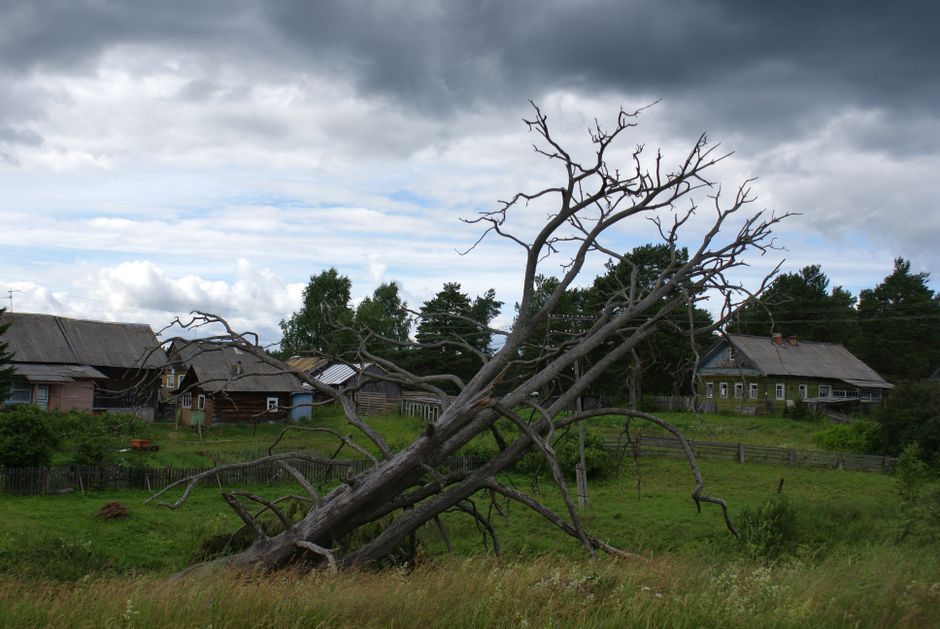
Once you have catalogued the defects, look at what is beneath and around each tree.
Occupancy matters as well as presence. A tree over a shed used twice a year presents different exposure from the same tree over a bedroom. This is why two identical trees on the same street can warrant different responses.
Twice a year is a reasonable rhythm for most properties, once before storm season and once after leaf drop when structure is easier to see. Walk each mature tree, look at the base, the trunk, and the canopy, and photograph anything that changed since last time.
Additional walks are worth doing after any significant storm and after drought, extended flooding, or nearby construction. Trees respond to stress on a delay, so problems often show up a season or more after the event that caused them.
Most findings do not mean removal. Dead wood is handled with dead wood removal, weak unions can sometimes be supported with cabling or bracing, heavy canopies can be reduced to lower wind load, and stressed trees in poor soil often respond to deep root fertilization. Regular tree trimming addresses a good share of what a walkthrough turns up.
Where the defect is severe and a target sits beneath it, removal is the appropriate answer. Our guides on when a tree needs to be removed and removing dead trees cover that decision, and storm damaged tree removal covers the post-event version.
A walkthrough tells you which trees need work now, which need watching, and which are fine. We provide assessments and tree removal across the communities on our service area page.
Contact Big Easy Tree Cutting or call 504-732-9714 to schedule one.
Risk assessment combines a defect that makes failure likely with something valuable positioned where the failure would land, along with the consequences of that impact. A severely decayed tree with nothing beneath it may present little risk, while a moderate defect over an occupied structure can present a lot. Both halves of the equation matter.
No. Trees compartmentalize decay and much of a trunk’s strength comes from its outer wood, so a hollow tree can stand for many years. What matters is the amount of sound wood remaining around the cavity, where the cavity sits relative to the load, and what is underneath. That assessment is worth getting from a professional rather than estimating.
Twice a year suits most properties, once before storm season and once after leaf drop when structure is easier to see. Add an inspection after any significant storm and after drought, flooding, or nearby construction. Trees respond to stress on a delay, so problems frequently appear a season or more after the cause.
Not necessarily. Many trees grow at an angle throughout their lives and build supporting wood to match. The concern is change, meaning a lean that is new or has increased, particularly when combined with heaved soil or exposed roots on the opposite side. Annual photographs from the same position make change much easier to detect.
Yes, and the delay is what makes it easy to miss. Severed structural roots and compacted soil from trenching, paving, or equipment traffic can compromise anchorage and health well before symptoms appear above ground. If work was done near a mature tree in the last few years, mention it during any assessment.
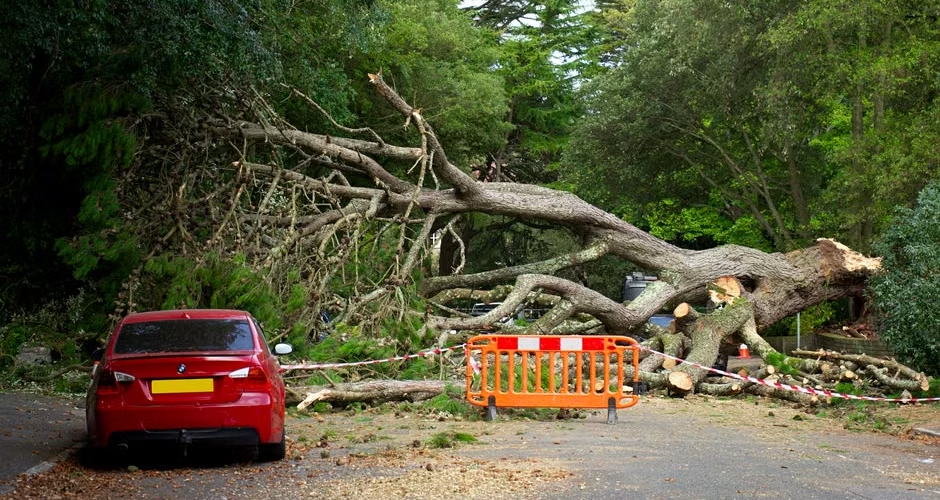
Consider what else is beneath and around it, including walkways, neighboring property, parked vehicles, and any area where people gather. Where nothing of value would be struck, monitoring may be reasonable rather than intervening. Where people or property are exposed, the same defect warrants a faster response.
 By Admin
  Sep 19, 2026