Call Us Now: 504-732-9714
Call Us Now: 504-732-9714

A tree touching or growing toward an electrical line is one of the few situations in tree care where the correct first call is not to a tree service. Responsibility is split between the utility and the property owner, the work requires specific qualifications, and the consequences of getting it wrong are severe. This guide explains who handles what, why the usual DIY calculus does not apply, and how removal near lines actually proceeds.
Electricity does not require contact to injure. Under the right conditions current can arc across an air gap, and green wood carries enough moisture to conduct. A saw, an aluminum pole pruner, a wet rope, or a falling limb can all complete a path to ground with a person in it.
This is why work near energized conductors is restricted to crews with specific line-clearance qualification, working under defined approach distances and often with the line de-energized or protected. General tree work training does not cover it. If a tree on your property is anywhere near a line, the safe assumption is that it is not an ordinary tree job, and Big Easy Tree Cutting will tell you when the utility needs to be involved first.
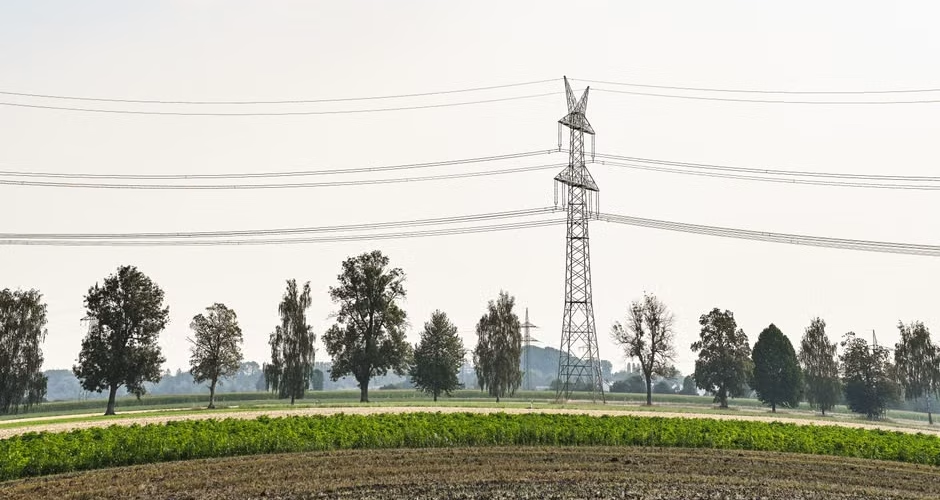
Knowing what you are looking at helps you know who to call.
Do not use the position on the pole to decide whether a wire is safe. Treat every line as energized. The distinction matters for who is responsible, not for how carefully you should behave around it.
Responsibility is commonly divided between the utility and the property owner, but the exact split depends on your utility, its tariff, and local practice. As a general pattern, utilities maintain clearance around their own distribution and transmission facilities on a cycle they set, while vegetation touching the service drop to an individual home is frequently treated as the property owner’s responsibility.
That general pattern is not a substitute for asking. In the New Orleans area, contact your electric utility directly, describe which wire the tree is contacting, and ask what they will handle and what falls to you. Get the answer before scheduling any work, because a tree service cannot begin near a conductor the utility has not addressed.
Utilities generally prune or remove vegetation that threatens their lines, prioritize reliability and safety, and can de-energize or apply protective covering when work must happen close to a conductor. They usually do this on their own schedule rather than yours, though hazards get faster attention than routine growth.
Trees entirely clear of the utility’s facilities, cleanup on private property, and often the vegetation around the service drop tend to fall to the owner. Removal of the whole tree, as opposed to clearance pruning, is also normally the owner’s project even when the utility has cleared its side.
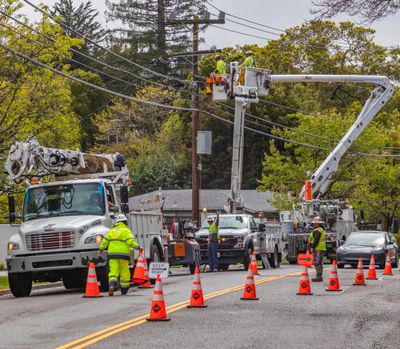
The sequence usually starts with a call to the utility rather than a saw. Once the utility has assessed the situation, options include pruning back their clearance zone, applying protective line covers, or temporarily de-energizing the circuit so a crew can work safely.
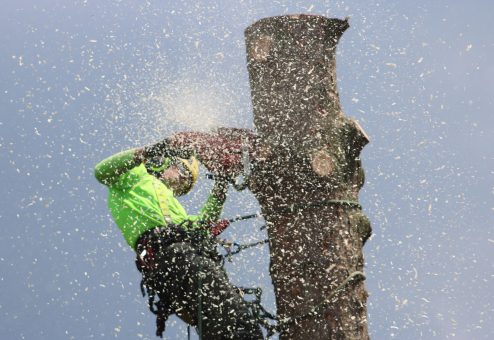
With the electrical hazard addressed, the removal itself proceeds much like any other controlled dismantling. Limbs on the line side come off first and are rigged away from the conductor rather than allowed to swing toward it. Sections are lowered under control, and the crew maintains approach distances throughout. Where the tree is large or unsound, a lift or crane keeps workers out of the canopy entirely, which our post on large tree removal covers in more detail.
Coordination is the part that takes time. Scheduling a de-energization involves the utility’s operations planning, and that lead time is usually longer than the removal itself.
Every argument for careful DIY tree work collapses when a conductor is involved. There is no protective equipment available at a hardware store that makes it acceptable, and there is no version of “I will just be careful” that accounts for an arc.
The failure modes are specific and fast: a limb rotating on the way down and contacting a line, a pole pruner touching a wire, a ladder shifting into a conductor, or a person on the ground touching a limb that is now energized. Our post on the dangers of DIY tree removal covers the mechanical hazards, and electricity sits in a category above all of them.
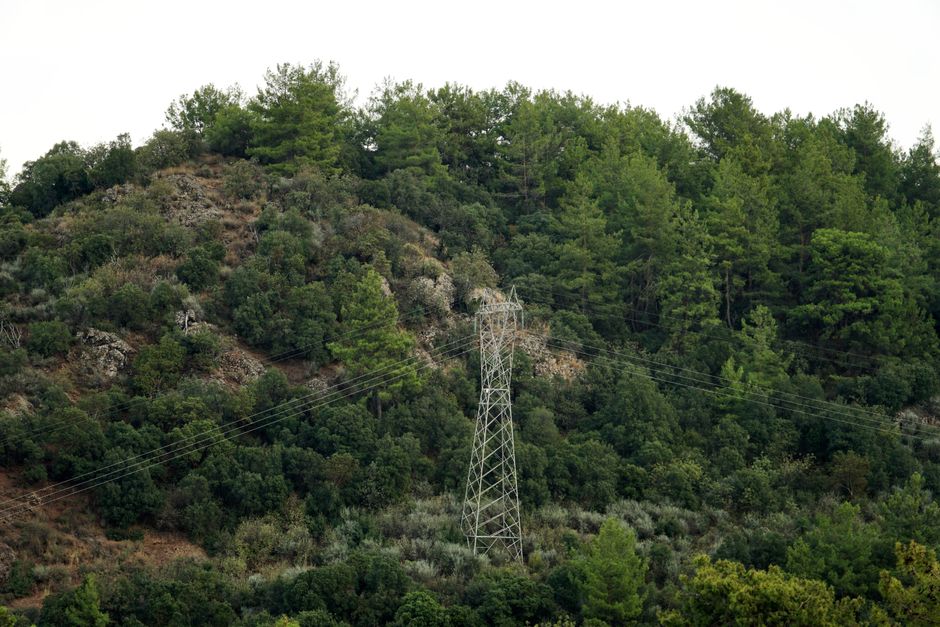
Most line conflicts are the result of planting decisions made decades earlier. A tree that will reach fifty feet planted under a distribution line guarantees a permanent conflict, and no amount of pruning resolves it without deforming the tree.
Where a young tree is already growing toward a line, directional pruning while it is small can steer growth away from the conductor. On mature trees, crown reduction and lifting can create clearance without removal in some situations. Regular tree trimming keeps growth from reaching a line in the first place, and pre-season work matters here, as our post on tree trimming during hurricane season explains.
Storm damage and power lines are a common and dangerous combination. Assume any downed wire is live, keep well back including from puddles and fences it may be touching, report it to the utility, and wait. A tree resting on a line is not a tree service call until the utility has cleared it. Our guide to emergency tree removal in Louisiana covers the full sequence, and our emergency tree trimming service handles the tree side once the site is safe.
If you have a tree growing into a wire, start by calling your electric utility, then call us to plan the tree work. We handle tree removal throughout the communities listed on our service area page, and our FAQs page answers more common questions.
Contact Big Easy Tree Cutting or call 504-732-9714 to discuss your situation.
Responsibility is commonly split, with the utility maintaining clearance around its own distribution and transmission facilities and the property owner often responsible for vegetation around the service drop to the house. The exact division depends on your utility and its tariff, so confirm directly with them which wire is involved and what they will handle before arranging any work.
Not while the line is energized and unprotected. Work close to conductors requires crews with specific line-clearance qualification working under defined approach distances, and the utility usually has to de-energize the circuit or apply protective covering first. Once the electrical hazard is addressed, a qualified tree service can complete the removal.
No. The service drop carries current and can be contacted by a limb, a pole pruner, or a ladder. Contact your electric utility about the drop before doing anything, and ask what they handle versus what falls to you. Treat every wire as energized regardless of its position on the pole.
Keep everyone well away, including from puddles, fences, and anything else the wire may be touching, and call your electric utility to report it. Call 911 if there is fire or if anyone has been hurt. Do not approach the tree or attempt any cutting until the utility confirms the line is clear.
Utilities generally focus on clearance around their facilities rather than on removing trees for a property owner’s benefit, though they may remove a tree that poses a direct threat to their lines. Removal of a tree for other reasons is normally the owner’s project. Ask your utility what they will do so you know what remains for you to arrange.
Match the mature size of the tree to the location. Species that stay small are appropriate beneath and near overhead lines, while large shade trees belong well away from them. Considering the mature height rather than the size at planting is the single most effective step, and directional pruning while a tree is young can help steer growth clear.
 By Admin
  Aug 29, 2026