Call Us Now: 504-732-9714
Call Us Now: 504-732-9714

Tree removal looks like a job you can do with a rented chainsaw and a free Saturday. It is one of the more dangerous tasks a homeowner can take on, because the forces involved are large, invisible, and unforgiving of a single misjudgment. This guide explains the specific mechanisms that injure people during do-it-yourself removals, the situations where the risk is highest, and where the line sits between reasonable yard work and a job for a trained crew.
A standing tree stores an enormous amount of potential energy. Wood under bending load holds tension on one side and compression on the other, and the moment a saw releases that balance the wood moves, sometimes faster than a person can react. None of this is visible from the ground.
Professional crews manage that risk with training, planned escape routes, rigging that controls where wood goes, and equipment that keeps people out of the fall path. A homeowner with a rental saw has none of those systems, and the consequences of getting it wrong are measured in hospital visits rather than do-overs. Big Easy Tree Cutting is called out to fix the results of DIY attempts often enough that the pattern is familiar.
When the upper tip of the guide bar contacts wood, the saw can rotate up and back toward the operator in a fraction of a second. It happens faster than a person can let go. Chaps, a helmet with a face shield, and a chain brake reduce the consequences, and most homeowners cutting an unfamiliar tree are wearing none of that.
If a felling cut is made incorrectly on a tree under tension, the trunk can split vertically and the back half can rear up and backward toward the operator. It is one of the fastest and most lethal failures in tree work, and it happens because of cut sequence rather than saw skill.
Predicting where a tree will land requires reading lean, canopy weight distribution, wind, and internal decay. A tree with a heavy limb on one side does not fall where its trunk points. Decay in the hinge wood removes the control that a properly cut hinge is supposed to provide, and the tree simply goes where its weight takes it.
Operating a chainsaw from a ladder is among the most dangerous things a person can do in a yard. The saw’s reaction forces have nothing to push against, and a cut limb frequently strikes the ladder on the way down. Climbing systems used by professionals exist precisely because ladders do not work for this.
Helpers standing nearby are hit by falling limbs, by wood kicking off a stump, and by pieces bouncing in unexpected directions. Everyone who is not cutting should be far outside the work area, and on a DIY job there is usually somebody standing exactly where they should not be.
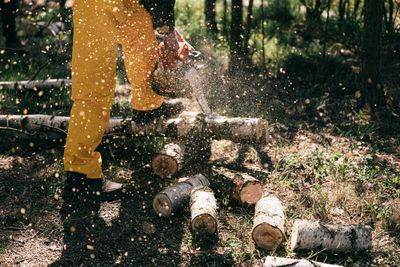
Any tree with branches near overhead conductors is off limits, full stop. Contact does not require touching the wire directly, because current can arc across a gap and wood that looks dry is often wet enough to conduct. A saw, a pole pruner, or a limb falling across a line can all complete a circuit.
Utility clearance work is done by crews with specific training and equipment for energized environments. If your tree is anywhere near a line, contact your electric utility rather than attempting the work or hiring a company that is not qualified for it. Responsibility for different parts of the system varies, so confirm with the utility what they handle and what falls to the property owner.
Injury is the worst outcome, though it is not the most common one. Trees dropped onto roofs, fences, sheds, vehicles, and neighboring property are a routine result of DIY removal.
That last item deserves emphasis. A tree that has been partially cut, with a hinge started and no plan for finishing, is a genuine hazard. It is also more expensive to deal with than the original job, because the crew now has to work with a structure someone else compromised.
Homeowners sometimes assume that damage from their own tree work is simply covered. Whether a policy responds to damage a homeowner causes while operating equipment depends on the policy language, the exclusions, and the circumstances, and it is not a question anyone should answer from general assumptions.
If a neighbor’s property or a person is involved, the questions get more complicated. Confirm with your insurer what your policy does and does not cover before starting work, and ask specifically about damage arising from your own tree cutting. When a licensed and insured company does the work, the risk sits with a party that carries coverage for it, and asking for a current certificate of insurance is a reasonable step. A certificate shows coverage was reported at a point in time rather than guaranteeing any particular claim, so verify with the issuing agency if the project is significant.
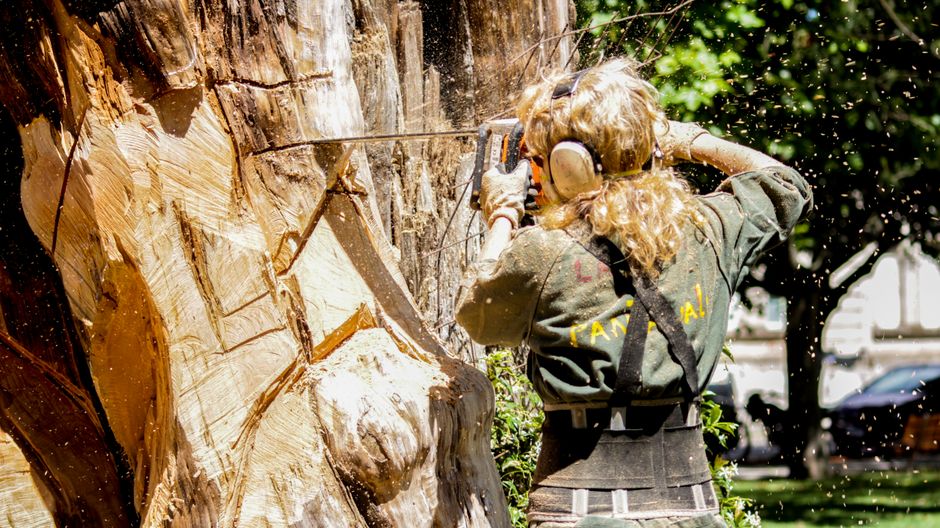
Plenty of tree work is reasonable for a homeowner. Small branches you can reach from the ground with hand tools, cleaning up brush after a crew has made the area safe, and light pruning on young trees are all normal yard maintenance.
The work moves into professional territory when any of the following is true: the job requires leaving the ground, the tree is taller than open space around it, anything valuable sits within the fall path, the tree is dead or decayed, wires are anywhere nearby, or the wood is under load from a storm. Our comparison of DIY versus professional tree removal goes deeper on that decision, and our post on DIY versus professional tree trimming covers the same question for pruning work. For basic ground rules, see our tree trimming safety tips.
There is no version of this where saving on a removal is worth an emergency room visit or a hole in your roof. If you have looked at a tree and felt uncertain, that instinct is worth listening to. Read our guide on when a tree needs to be removed and our breakdown of how long tree removal takes to see what the job actually involves.
We handle tree removal and stump grinding across the communities on our service area page. Contact Big Easy Tree Cutting or call 504-732-9714 for an estimate.
Size matters less than surroundings and whether the work can be done from the ground. A small tree with clear space around it and nothing valuable within its fall path is a different proposition from a similar tree beside a fence or under a wire. If the job requires a ladder or a climb, or if anything of value sits within reach of the tree, it belongs to a trained crew.
A saw is only one part of the equipment involved. Professional removals also rely on climbing or lift access, rigging to control where wood goes, wedges, felling levers, and personal protective equipment including chaps, a helmet with face and hearing protection, and cut-resistant boots. The training that determines cut sequence matters more than any of the hardware.
A barber chair happens when a trunk splits vertically during felling and the back portion rears upward toward the operator. It typically results from an incorrect cut sequence on a tree under tension rather than from a lack of saw skill. It occurs very quickly and leaves almost no time to move, which is why cut technique is taught before anyone is allowed to fell a tree.
No. Electricity can arc across a gap without direct contact, and green wood conducts. Work near energized conductors requires crews with specific training and equipment. Contact your electric utility about branches near lines and confirm with them which parts of the system they maintain and which fall to the property owner.
That depends on your policy language, its exclusions, and the circumstances of the loss, so the only reliable answer comes from your insurer. Do not assume coverage applies to damage you cause while operating cutting equipment. Ask your agent directly before starting any work, and get the answer in writing if the tree is near a structure.
Stop, move everyone well clear, and keep the area empty until a professional arrives. A partially cut tree with a started hinge is less predictable than an untouched one and should not be approached. Call a tree service, describe exactly what cuts were made and where, and let them plan the recovery.
 By Admin
  Aug 11, 2026